New whitepaper supports ship owners in navigating rising barnacle biofouling risks ahead of tightening biofouling management rules
I-Tech AB, developers of Selektope, has published a new industry whitepaper offering shipowners, operators, and technical managers a practical, data-driven guide to understanding, assessing, and mitigating the growing operational and commercial risks posed by barnacle biofouling.
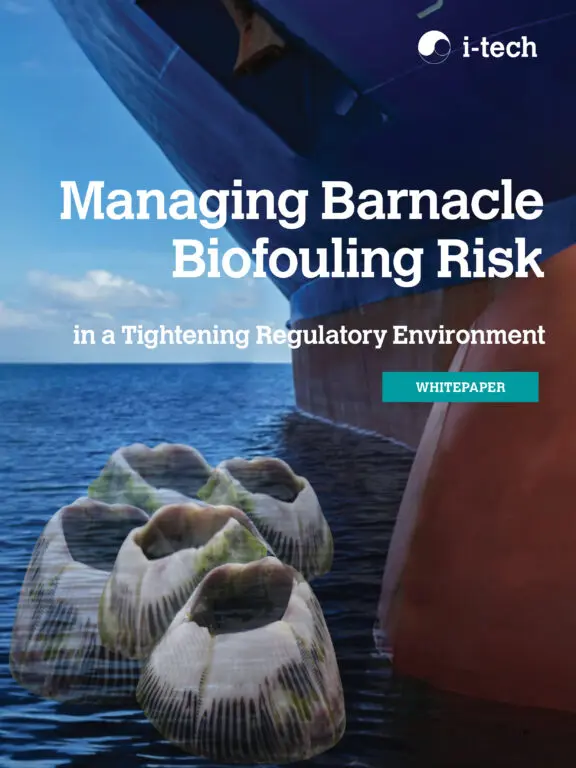
Drawing on extensive independent analysis of hull condition data by the Safinah Group, alongside key findings from leading academic and industry studies, the whitepaper reveals how, where, and why barnacle fouling develops across the global fleet and how coating choice influences risk. It also provides practical strategies to help ship owners manage risk, protect vessel efficiency, and maintain compliance with evolving biofouling and decarbonisation regulations.
Growing risk in a tightening regulatory landscape
As international biofouling management regulation moves steadily towards mandatory enforcement, and the number and stringency of regionally enforced mandatory rules increase, the new whitepaper — Managing Barnacle Biofouling Risk in a Tightening Regulatory Environment — provides the perfect tool for ship operators to act on controlling barnacle fouling below the waterline.
Barnacles are widely recognised as one of the most commercially damaging forms of marine biofouling. This is due to their strong adhesion to hull surfaces and their significant impact on hydrodynamic drag, which reduces vessel efficiency, increases fuel consumption, undermines decarbonisation efforts, threatens regulatory compliance, and negatively affects long-term profitability.
According to one academic study referenced in the whitepaper, as little as 10% barnacle coverage on an underwater hull may require up to 36% more shaft power to maintain speed, driving higher fuel consumption, greenhouse gas emissions, and voyage costs.
However, successful prevention of barnacle fouling on the hull yields multiple significant benefits for ship operators. Maintaining clean hulls is one of the few vessel efficiency measures capable of delivering immediate commercial and regulatory benefits across several environmental regulatory frameworks simultaneously. This includes Carbon Intensity Indicator (CII) ratings, and, for vessels operating in the European Union (EU), cleaner hulls reduce exposure to Emission Trading Scheme (EU ETS) and FuelEU Maritime costs, without any changes to propulsion systems, technology use or fuel choices.
Coating choice as a critical risk factor
Building on earlier studies published by I-Tech that seek to quantify barnacle fouling across the global fleet, this latest whitepaper places a new spotlight on the role of antifouling coating selection in determining barnacle fouling risk.
Through independent analysis of hull condition data from the drydock inspections comparing the two principal coating technologies used across the global fleet, self-polishing copolymer coatings and foul-release systems, the report concludes that coating technology choice has a significant influence on both the severity and variability of barnacle attachment. The findings in the whitepaper indicate that coating grade and suitability for the vessel's operational profile are critical to long-term performance.
The whitepaper contains one of the most extensive independent reviews of barnacle fouling prevalence to date, published by I-Tech in 2025, wherein the analysis of hull condition for 686 vessels inspected in drydock over a ten-year period confirmed that more than one in three vessels entered drydock with barnacles covering more than 10% of the hull, while nearly one in five exceeded 20% coverage.
“Coating selection should no longer be viewed as a periodic purchasing decision based primarily on drydock budget,” says Per Svensson, Sales Director at I-Tech. “It needs to be treated as part of mainstream efficiency management with barnacle fouling specifically in mind. The wrong coating for the wrong operating profile, or a change in a vessel’s operating profile, can lock in years of avoidable fuel loss, higher emissions, and additional maintenance intervention.”
Innovations unveiled: Barnacle fouling and foul release coatings.
Findings in the new whitepaper shows that ships with foul-release coating systems, who are dependent on biofouling removal by motion and regular ship activity to perform, can become vulnerable to barnacle settlement during prolonged idle periods, extended warm-water exposure and low-speed operation, particularly in areas where the coating surface has suffered mechanical damage.
Alongside conventional coating comparisons, the whitepaper presents findings from testing an experimental foul-release coating system incorporating Selektope®, I-Tech’s barnacle-repelling active ingredient. The results demonstrate strong resistance to barnacle settlement—even when coating surfaces are mechanically damaged—highlighting a potential new direction in antifouling technology that combines foul-release functionality with targeted prevention of hard fouling.
Increasing exposure from operational and environmental trends
Beyond coating performance, the report identifies broader operational and environmental trends that are intensifying barnacle biofouling exposure across the shipping industry.
Low-speed steaming, longer idle periods, anchorage congestion, and warm-water trading routes continue to create more favourable conditions for barnacle attachment, particularly for tankers and bulk carriers. As unplanned idling during operations has increased in recent years - coating selection has become even more complex, as it must account for extended and unpredictable idle periods during normal operations. Climate change is also highlighted as a major risk multiplier, with rising sea temperatures accelerating barnacle growth rates, extending fouling seasons and expanding high-risk regions into new geographical areas.
The whitepaper concludes that since barnacle removal remains costly, disruptive, and potentially damaging to coating systems, prevention offers the most sustainable and commercially effective solution. Recommendations suggest that coating selection, idle-time management and awareness of high-risk fouling conditions must now be fully integrated into both technical and commercial decision-making as regulatory pressure increases globally.
Download the whitepaper.
Managing Barnacle Biofouling Risk in a Tightening Regulatory Environment is available to download here.

Related articles

The Discovery That Changed Marine Antifouling
International Antifouling Conference to return in 2027 as shipping industry prepares for future global biofouling rules

New Sales Director Joins I-Tech team to lead global Selektope sales