Unlocking the Science Behind Selektope®
Part 2: Understanding How to Make Barnacles Swim Away
In the first chapter of the Selektope story, we explored how scientists working on a Marine Paint project in Gothenburg in the early 2000s discovered a new antifouling substance that could repel barnacle larvae from a coated surface.
For the scientists behind what would eventually become the antifouling technology, Selektope®, the next chapter of the story was all about unlocking the mystery of how a substance used to sedate mammals in veterinary medicine induced the opposite effect of “kicking” behaviour in barnacle larvae in early experiments.
Also, further questions needed to be answered: What concentrations would be needed to achieve the desired effect? How could this substance be incorporated into marine paint, with sustainable release? And, crucially, what would happen beyond the target organism and in the wider marine environment?
Answering these questions would require years of research, experimentation and scientific investigation…
The 2000s: Identifying the mechanism
As the new millennium began, patents were filed for using Selektope in marine paints. In 2000, I-Tech AB – originally Interface Technologies AB – was founded to hold the patents and take the technology towards commercialisation.
The newly established company was initially hosted by the University of Gothenburg's incubator, with grants and business angel investment supporting the early development work.
Throughout the first decade, researchers investigated medetomidine to understand why it worked and whether that mechanism could form the basis of a reliable antifouling technology.
One of the major scientific breakthroughs came through research carried out in collaboration with two Finnish universities.
Researchers discovered that medetomidine could bind to a specific group of receptors in barnacles known as octopamine receptors. The receptors were cloned, and the causal relationship between the receptor and Selektope was identified. Further research then linked this receptor interaction to changes in the behaviour of barnacle larvae at a coated surface.
This helped explain the unusual behaviour that scientists had observed in their earlier experiments. Although medetomidine is known for its sedative effects in vertebrates, in barnacle larvae it produced almost the opposite response, inducing hyperactivity that disrupted the settlement process. Researchers likened the effect to a small dose of adrenaline in humans.
The “kicking response” observed in the cyprid larvae was temporary, meaning the larvae were not being killed. Instead, their behaviour was altered in a way that prevented them from settling on the surface.
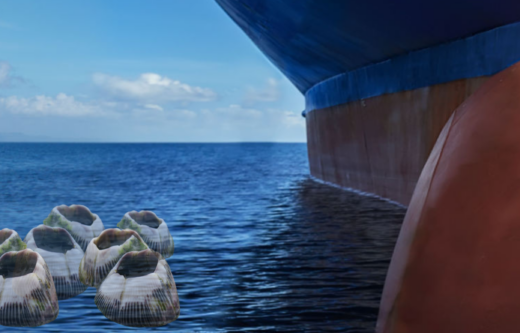
This was significant because it pointed towards a fundamentally different approach to antifouling: rather than relying on a killing effect to prevent barnacles, could they simply be encouraged to swim away before they had the opportunity to attach?
How little is enough?
Understanding the mechanism was one part of the challenge; determining how much medetomidine was needed in the coating to achieve the desired effect was another.
As the research progressed to panel testing and larger-scale trials, the results continued to demonstrate the potential of the technology. In one panel test, a paint containing Selektope at just 0.02% by weight rejected 97% of barnacles (Balanus improvisus) after two weeks and 96% after four weeks. No other macrofouling organisms were observed during the test.
The results were encouraging, but they immediately raised another, much bigger question: could something that worked so effectively on a laboratory panel also work across the hull of a 200 or 400-metre ship and how would it perform after longer periods in water?
A commercial antifouling coating would need to perform across thousands of square metres of underwater hull, in real marine conditions and over extended periods. The laboratory could provide evidence of the mechanism and demonstrate the potential of the technology, but there was still a considerable distance to travel before that knowledge could be translated into a product for the global shipping industry.
What happens beyond the barnacle?
Understanding how Selektope affected barnacle larvae was only part of the challenge. For use in marine coatings, researchers also needed to understand how the substance behaved when released from the paint and its potential impact on the marine environment.
This research became an important part of the scientific evidence supporting Selektope’s regulatory approval and responsible commercial use. But building that regulatory case would bring a new set of challenges.
Conquering the regulatory valley of death
By 2006, I-Tech had entered a new stage of development, initiating the registration of Selektope as a marine antifouling active substance.
Turning Selektope into a product that paint manufacturers could use was a complex process, particularly because of the time and investment required to obtain the necessary regulatory certifications and permissions.
I-Tech made the strategic decision to seek approval under the European Union's newly implemented Biocidal Products Directive 98/8/EC (BPD). For a new biocidal substance, this meant demonstrating not only that the substance worked, but that its use would not pose unacceptable risks to people or the environment.
The regulatory requirements were extensive. I-Tech spent around six years generating the data required to conduct human and environmental exposure and risk assessments. By 2009, the company submitted a regulatory dossier containing approximately 70 original studies on Selektope, and by the end of the evaluation process, that number had grown to around 90.
The financial commitment was substantial too. Developing the data package required for an EU biocide approval could involve an investment of approximately €5–10 million, representing a formidable barrier for a small technology company.
This is the classic technology “valley of death”: the point at which a promising scientific discovery must survive the enormous cost, complexity and uncertainty involved in turning it into a commercially viable product.
In I-Tech's case, patient and committed owners supported the company through the process, while an existing toxicology data package generated during the development of medetomidine as a pharmaceutical substance helped reduce some of the financial burden.
From scientific discovery to Selektope®
After years of research, experimentation and regulatory work, the scientific foundation for Selektope was becoming firmly established.
Researchers had investigated how Selektope interacted with barnacle larvae, established the role of octopamine receptors in the behavioural response, determined the concentrations required to produce the desired effect, studied how the substance behaved in marine coatings and examined the potential environmental risks associated with its use.
The technology had come a long way from the original observation that barnacle larvae could be prevented from settling.
But there was still one enormous question to answer: Would it actually work on ships?
Find out more about Selektope's entry into the commercial market and how the use of this unique antifouling technology was upscaled in the next article in the series.

Related articles

The Discovery That Changed Marine Antifouling
International Antifouling Conference to return in 2027 as shipping industry prepares for future global biofouling rules

New Sales Director Joins I-Tech team to lead global Selektope sales