From Innovation to Adoption
Part 3: How 63 Months at Sea Put Selektope® to the Test
Making a scientific discovery is one thing. Turning that discovery into a technology that can be successfully applied in the real world is quite another.
Imagine designing what you believe to be the perfect aeroplane. You build it, test its components and demonstrate that it can fly. But who is prepared to take the first flight? And, more importantly, will it perform well enough to enter commercial service?
While I-Tech doesn't operate in the aviation sector, instead, we develop technology for industries that make use of the sea; the challenge of taking an innovation from the drawing board to commercial reality is much the same.
By 2015, more than a decade of research, development and regulatory work had taken Selektope from an unexpected scientific discovery to a new antifouling technology ready for commercial use.
The science was established. The first coating had been developed. But one critical question remained: Would someone trust it on an entire ship?
Bringing a new technology into commercial shipping means asking someone to go first. A vessel coating is expected to protect thousands of square metres of underwater hull for years at a time. There is little room for experimentation once the ship leaves drydock.
For Selektope, that first major test would come aboard M/V Calypso.
From the laboratory to the high seas
In November 2015, Laurin Maritime's 46,067 dwt chemical and products tanker, Calypso, received a full hull application of SEAFLO NEO CF PREMIUM, a new copper-free antifouling coating containing Selektope.
Developed by Japanese marine coatings manufacturer Chugoku Marine Paints (CMP), it was the first commercial coating product to incorporate Selektope.
CMP was an early adopter of the technology, committing considerable research and development resources to develop a commercially viable coating formulation. Its investment in trials and performance data gathering helped translate Selektope's innovative mode of action into a product suitable for commercial shipping.
But the first full-vessel application required another important commitment. Laurin Maritime agreed to put one of its working vessels forward, providing I-Tech with the opportunity to evaluate the coating under real commercial operating conditions.
Applied to Calypso's flat bottom and vertical sides during its five-year drydocking in Singapore, the coating marked a landmark moment for I-Tech, CMP and Laurin Maritime.
For I-Tech, commercialisation meant more than making Selektope available to paint manufacturers. It meant working alongside coating partners and shipowners to build the real-world evidence needed for a new technology to earn the industry's confidence.
A project built around data and scrutiny
From the outset, the Calypso project was centred on collecting evidence. It was not enough to demonstrate that the hull appeared clean. I-Tech wanted to understand how the coating performed throughout the vessel's operating life and whether this translated into measurable improvements in vessel performance.
Independent hydrodynamic analysis by Propulsion Dynamics used operational data, including fuel consumption, power output and speed, to assess changes in hull and propeller resistance. Calypso's performance could then be compared against benchmarks derived from a substantial database of other vessels.
The operating profile made Calypso a demanding test case. During the five-year period, the vessel regularly traded in warm waters and experienced several extended periods of inactivity, including three periods of more than 14 days in waters above 25°C. Warm water combined with vessel inactivity creates a much higher risk for barnacle fouling occurring.
Two years at sea: the evidence builds
By January 2018, Calypso had completed 24 months of operation with the Selektope-containing coating.
The independent analysis showed that the vessel's total added resistance had increased by just 7%, compared with an expected increase of 10–20% for a benchmark new vessel. Its speed loss relative to sea trial performance was just 2%.
Crucially, the performance data were supported by physical underwater hull inspections. Divers examined the port and starboard vertical sides, flat bottom and bilge areas, finding no evidence of soft or hard fouling.
The results provided encouraging evidence that the coating was maintaining hydrodynamic performance while protecting the hull against marine fouling. But with the coating specified for a 60-month service life, there was an opportunity to build an even longer performance record.
5 years at sea: the ultimate test
In February 2021, after 63 months of global trading, Calypso entered drydock in China.
There had been no hull cleaning. No mechanical intervention. No diver cleaning.
And immediately before drydocking, Calypso had spent an entire month at anchor off the Chinese coast, creating one final demanding test for its antifouling protection.
When the vessel came out of the water, the result was clear.
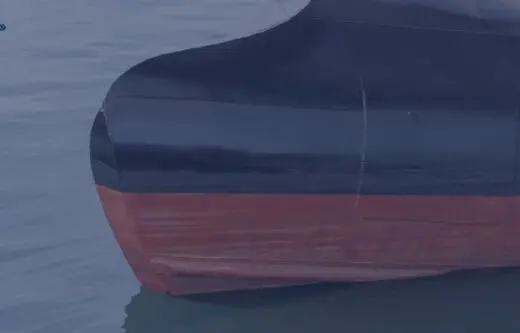
After more than five years in service, there was no barnacle growth on the hull.
The coating showed the wear expected after 63 months at sea. But the barnacle protection remained.
For the first full-vessel application of Selektope, it was a powerful piece of real-world evidence
Measuring the impact of Selektope
Physical inspections were only part of the evaluation. For the longer-term assessment, Molflow's AI-powered ship-modelling tool, Slipstream, analysed Calypso's operational data.
The analysis calculated an average annual speed loss of less than 0.5%, equivalent to approximately 0.06 knots.
The findings also had direct commercial relevance. Team Tankers compared Calypso's performance against nine sister vessels in its fleet and found its speed losses were significantly lower.
Capt. Pär Brandholm, Senior Performance & Technical Manager at Team Tankers International at the time, commented:
"The fact that the average weighted speed loss is significantly lower than for other vessels in our fleet, is hugely impressive – and will have a tangible impact on fuel costs and emissions."
Calypso demonstrated how effective barnacle prevention could help protect vessel efficiency, with potential benefits for fuel consumption, operating costs and emissions.
The next chapter of the story
Calypso represented far more than a successful first full-vessel application. It marked the point at which years of scientific research began translating into long-term commercial evidence.
What started with an unexpected observation in a laboratory had now travelled the world's oceans performing on a vessel for more than five years.
During those five years, many more vessels were coated with Selektope-containing coatings.
Buoyed by good performance at sea, Selektope use began to increase year-on-year in parallel with an increasing number of marine coatings products containing the technology launched onto the market by different coatings manufacturers.
In the concluding chapter of the Selektope story, we explore how Selektope became a trusted tool in the armoury of leading marine paint manufacturers, as a go-to product for barnacle fouling protection for thousands of vessels.
We also look at what the future holds for Selektope in the concluding article in the series.
Click here to read the full case study for the Calypso vessel project.

Related articles
When regulation and sustainability ambitions collide: What the Selektope decision means for the future of marine antifouling
Unlocking the Science Behind Selektope®

The Discovery That Changed Marine Antifouling