Making sense of hull performance: a reflection from HullPIC 2026
"And so the whole way of using numbers, of calculating, changed in the 15th and early 16th century.” The transition from Roman numerals to modern arithmetic reshaped how people understood the world — driven by necessity and enabled by new tools.
Standing in the historic monastery of Pontignano during HullPIC 2026, that idea felt unexpectedly relevant.
Because shipping today is going through a similar shift: from estimated performance to measured reality, from simplified assumptions to data-driven decisions. The contrast between the centuries-old setting and the forward-looking discussions made that shift particularly tangible.
From simplified assumptions to real-world complexity
Across many of the presentations, a consistent shift became visible. The industry is moving away from static assumptions and simplified models, towards measured data, multi-factor modelling, and a much stronger focus on real operational variability.
At the same time, this transition is not making things simpler — quite the opposite. It is exposing how complex hull performance actually is in practice.
Hull condition is no longer just treated as a technical parameter. It is increasingly becoming a question of:
• how well it can be measured
• how reliably it can be interpreted
• and ultimately how it translates into cost and compliance
Fouling: well understood, but hard to quantify
Fouling is a well-known issue, but translating it into consistent, data-driven insights remains challenging.
Several presentations confirmed that even light slime can have a measurable effect on resistance, while more advanced fouling — especially barnacles — can lead to significant performance penalties.
At the same time, fouling cannot be described with a single trend or simplified curve. It develops differently depending on route, idle time, environmental conditions and vessel operation. This makes it difficult to isolate and quantify its effect without robust normalization and modelling.

When fouling becomes a financial outcome
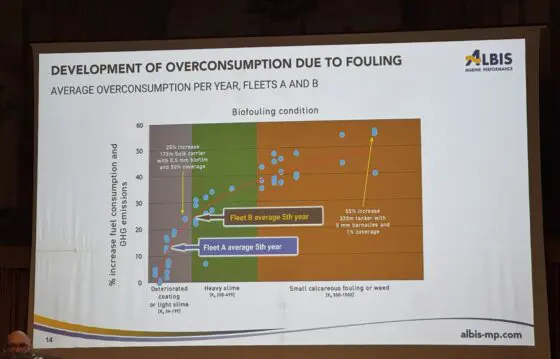
One study comparing two fleets under different commercial conditions illustrated how behaviour can shape performance.
This case highlights the value of proactive biofouling management. One fleet, operating in a market where fuel efficiency mattered, took active steps to maintain clean hulls, while another fleet—less impacted by fuel costs—allowed more fouling to accumulate. Over a five-year drydock period, the proactive fleet experienced about 13% extra fuel consumption (with roughly 4% reduction in speed), whereas the less managed fleet saw up to 25% higher fuel use and approximately 7.5% speed loss. These results clearly show that staying ahead of biofouling leads to better operational performance and significant fuel savings.
The increase was not linear. Performance loss accelerated over time, particularly in the absence of intervention.
The data highlights how even modest fouling can substantially affect vessel efficiency. Initial slime accumulation—just 0.5 mm thick and only partially covering the hull—was shown to drive fuel consumption up by as much as 25% in some instances. When fouling progresses to macrofouling, the performance penalty grows considerably, with recorded examples indicating fuel usage can rise by up to 55%. This underscores the importance of staying ahead of fouling to avoid escalating operational costs and maintain optimal performance.
At fleet level, the financial consequences become substantial. For a fleet of 25 vessels consuming around 25 tons per day and operating 250 days per year, the cost difference between the two approaches reached approximately $4.3 million in the first year, rising to over $13 million by year four. On average, this translates to roughly $14 million in additional annual fuel cost.
What stands out is that the difference in fouling rates between the two fleets was largely a result of inadequate biofouling management plans and maintenance strategies. The way each fleet approached maintenance directly impacted hull conditions, data quality, and operational decisions. Allowing fouling to accumulate is not simply a technical shortfall—it represents a multi-million-dollar business decision.
When data meets reality: coating performance over time
Another recurring theme was the gap between theoretical coating performance and real‑world outcomes, driven by how well coating systems aligned with operational realities.
Data from more than 50 bulk carriers operating in high‑fouling regions showed wide performance variation even within the same coating category. Differences between modelled expectations and actual performance were largely explained by fouling development and how coatings performed under real operating and maintenance conditions over time.
The comparison between coating types was particularly telling. While some FRC systems offered strong initial performance, they were more sensitive to mechanical damage, leading to faster degradation once compromised. Certain SPC systems, by contrast, showed more stable and predictable performance, despite slightly higher initial resistance.
These findings highlight that lifecycle performance—not peak performance—ultimately determines economic outcomes. Fuel consumption dominated total lifecycle cost, whereas coating CAPEX played a comparatively minor role.
What mattered most was the compatibility between a vessel’s operating pattern, maintenance approach, and coating system. Without that alignment, even high‑performing coatings failed to deliver sustained value over time.
From components to systems
Hull performance is increasingly understood as the result of an interconnected system rather than a single component, where coating, operation, cleaning and data monitoring all interact.
Digital tools are beginning to connect these elements. AI-based inspection and image recognition are making fouling condition more measurable and repeatable, while predictive models — combining physics and machine learning — are being explored to anticipate fouling development and optimize intervention timing.
However, their effectiveness still depends heavily on data quality. Without reliable input, even advanced models can produce misleading results.
Overall, this points towards a more continuous and integrated approach to performance management, where monitoring, prediction and intervention are increasingly connected.

Hull performance is becoming measurable — and accountable
Another important shift is the growing link between performance, emissions, and regulation.
Hull conditions directly affect resistance and fuel consumption, and therefore emissions. What is changing is that emissions are now being measured, reported, and increasingly tied to financial mechanisms such as CII, EU ETS, and FuelEU Maritime.
As a result, performance deviations are becoming more visible and, in many cases, directly monetized.
At the same time, biosecurity regulations in certain regions introduce additional risks. Heavily fouled vessels may face inspections, mandatory cleaning, or even operational restrictions. Fouling is therefore no longer just an efficiency issue, but one that can affect compliance and commercial viability.
Closing reflection
From the historical shift in how numbers were used to today’s effort to better understand vessel performance, the underlying driver remains the same: the need to make better decisions with better data and information.
Hull performance sits at the intersection of fuel cost, operational decisions, and regulatory pressure. Understanding it requires not only better tools, but better data, clearer methodologies, AI machine learning, and alignment between technical insight and commercial incentives.
References (HullPIC 2026 Programme)
- Cost-Benefit Analysis of Hull Coating Technologies for Swire Shipping & Bulk Vessels: A Comparative Study of SPC and FRC Performance – Swire Shipping Swire Shipping (shipowner / case owner)
- Development of Hull Fouling over the Docking Period: A Comparison of Two Fleets – ALBIS Marine Performance ALBIS Marine Performance (Albis MP) (performance analytics provider)


Related articles
I-Tech at the Ship Energy Efficiency Conference 2026 in Athens
Driving maritime sustainability forward: I-Tech at key EMSA and SEA Europe meetings in Lisbon
I-Tech Renews Membership in the Ballastwater & Environmental Manufacturers Association (BEMA)