When regulation and sustainability ambitions collide: What the Selektope decision means for the future of marine antifouling
Shipping is under increasing pressure to improve efficiency, reduce emissions and protect marine biodiversity. Effective biofouling control is part of delivering all three.
Against this background, the EU decision not to renew medetomidine, the active substance in Selektope®, deserves more than a regulatory footnote.
For I-Tech, the outcome is clearly disappointing. But the bigger question extends far beyond one company or one technology:
A decision worth questioning - Are we narrowing the antifouling toolbox when shipping needs it most?
Shipping is being asked to do more.
Reduce emissions. Improve efficiency. Protect marine biodiversity. Adopt new technologies. Move faster towards decarbonisation.
And if you work anywhere around vessel performance, you know that biofouling is part of that equation. A fouled hull creates resistance. Resistance costs fuel. And biofouling can carry invasive species from one marine environment to another.
So, here's the question we've been asking ourselves:
At a time when shipping needs more effective ways to manage biofouling, does it really make sense to remove one of the vital tools to do so?
Because that is where we now find ourselves with Selektope in the EU.
The EU has moved towards non-renewal of medetomidine, the active substance in Selektope.
Naturally, we are disappointed.
But rather than simply telling you that we disagree, we'd like to explain why.
Because when you look more closely at how we got here, we believe there are questions the wider maritime industry should be asking too.
It started with a scientific disagreement
At the heart of the process is the classification of medetomidine as having endocrine-disrupting properties.
We have consistently questioned the scientific basis for that conclusion.
Why?
Under the EU criteria, endocrine activity alone is not enough to identify a substance as an endocrine disruptor. There must also be an adverse effect, and a biologically plausible link between the endocrine activity and that adverse effect.
We do not believe that the required adversity has been convincingly demonstrated for Selektope. That remains a fundamental part of our scientific disagreement.
There is something else worth knowing.
Selektope (medetomidine) was originally developed as a pharmaceutical sedative. The effects underpinning the ED conclusion were observed at high, pharmaceutical-level doses, where medetomidine produces its known pharmacological effects. These are temporary and reversible and occur under conditions fundamentally different from Selektope's use in antifouling coatings, where it is used at ultra-low concentrations.
And this is where we think the question becomes important not just for us, but for anyone interested in how environmental technologies are regulated:
Should effects observed alongside the intended pharmacological action of a substance at high doses determine the regulatory future of that substance when used at vastly different exposure levels and for an entirely different purpose?
We don't believe that question has been satisfactorily resolved.
And yet, that conclusion set the direction for what came next.
Then we come to the alternatives
Once the ED conclusion had been reached, another question became critical:
If Selektope disappears from the European market, what replaces it?
According to EU expert groups - there appear to be plenty of alternatives.
Look a little closer and the picture becomes more complicated.
Selektope was developed specifically to prevent the settlement of barnacles. Many technologies included in the alternatives discussion do not provide the same functionality against hard fouling.
Industry feedback challenged the alternatives analysis on precisely this point. I-Tech's material highlights that only a limited number of the alternatives identified have sufficiently comparable functionality against barnacle fouling, while questions also remain around whether alternative solutions can provide equivalent protection across all vessel types and operating profiles.
Which leads us to another fairly simple question:
Can something really be called an alternative if it doesn't solve the same problem?
For a shipowner dealing with barnacle fouling, that distinction is not academic.
It affects how well a vessel performs.
The industry was asked. But was it heard?
This is perhaps one of the most frustrating parts of the story.
The European Commission opened a public consultation to gather evidence on what a non-renewal could mean.
And the industry responded.
Around 50 stakeholders submitted information, including shipowners, coating manufacturers, active-substance suppliers, trade organisations and antifouling experts.
Different organisations. Different interests. Different parts of the value chain.
Yet many of the concerns were remarkably similar.
Stakeholders pointed to the limited availability of comparable solutions against hard fouling. They highlighted the importance of effective antifouling for fuel efficiency and emissions reduction. They rebuffed the conclusion that non-biocidal technologies could simply replace existing solutions across every vessel and operating profile. And they raised concerns about EU competitiveness and the wider consequences of reducing the antifouling toolbox.
subsequently raised concerns that this extensive stakeholder input had not been sufficiently reflected in the process.
Of course, consultation doesn't mean industry should decide the regulatory outcome.
But surely consultation must mean something.
So we think it is fair to ask:
If stakeholders across the maritime value chain tell you that the proposed alternatives may not actually be equivalent, how much weight should that evidence carry?
And what would the industry have needed to demonstrate for the result to be different?
And then there is the part we think has received too little attention
What do we lose?
That question matters.
Because when discussing the environmental profile of an antifouling technology, shouldn't we consider both sides of the equation?
What are the potential effects of using the technology?
Absolutely.
But also:
What are the consequences of not having it?
Biofouling creates drag. Drag increases the power needed to move a vessel through water. That translates into higher fuel consumption and emissions.
Biofouling can also transport organisms between marine environments, contributing to the spread of invasive species.
Effective antifouling therefore isn't simply about keeping a hull looking clean.
It is part of keeping ships efficient.
It is part of reducing unnecessary fuel consumption.
And it is part of protecting marine ecosystems.
So, shouldn't those benefits be part of the equation too?
We believe they should.
This is where the decision becomes difficult to reconcile
Take a step back for a moment.
Europe wants shipping to decarbonise.
We want vessels to consume less fuel.
We want to limit the spread of invasive species.
We want a competitive European maritime industry.
And we want companies to continue investing in new environmental technologies.
At the same time, EU is removing from its antifouling toolbox a technology developed specifically to combat one of shipping's most difficult forms of fouling.
Are those ambitions pulling in the same direction?
The history of Selektope makes that question particularly interesting.
Selektope's commercial development was itself supported through European innovation policy, with the ambition of bringing a new, sustainable antifouling technology to the global maritime market.
Now, EU's regulatory framework is moving towards excluding this same technology from antifouling use in the EU.
There is an irony in that.
But there is also a serious policy question.
We are not suggesting innovative technologies should receive lighter regulatory scrutiny.
Quite the opposite.
They should withstand rigorous scientific assessment.
But shouldn't the assumptions used to remove an established technology be subjected to equally rigorous scrutiny?
Because shipping doesn't need one solution. It needs a toolbox.
Anyone working with biofouling knows there is no universal answer.
A vessel moving continuously through warm waters faces one challenge. A vessel spending extended periods idle faces another.
Speed matters. Trading pattern matters. Water temperature matters. Idle time matters. Coating type matters.
Which is why the future of biofouling management will almost certainly involve a combination of solutions.
Better coatings.
Better monitoring.
Better cleaning.
New surface technologies.
And appropriately regulated biocidal technologies.
We need more innovation, not less.
That is why we believe the Selektope case deserves attention beyond stakeholders directly impacted by the decision.
Our concern is not only what this decision means for one active substance today.
It is what the approach could mean for the development and availability of antifouling technologies tomorrow.
Because if technically valuable technologies gradually disappear while genuinely equivalent replacements are not yet available, the toolbox gets smaller.
And the problem we are trying to solve doesn't.
We're not arguing against regulation
We want to be very clear about that.
We expect Selektope to be scrutinised.
We expect difficult questions about safety, science and environmental impact.
We expect to have to demonstrate why our technology should be used.
But we think it is reasonable to ask equally difficult questions of the decision to remove it.
Has the adversity required to support the ED conclusion been convincingly demonstrated?
Are the proposed alternatives genuinely able to provide equivalent hard-fouling protection?
Was the evidence submitted by the maritime industry given sufficient weight?
Have we properly considered the environmental and societal benefits of effective fouling prevention?
And perhaps most importantly:
What happens if Europe continues to narrow its antifouling toolbox faster than new solutions can replace the ones being lost?
These aren't questions just for active substance manufacturers such as I-Tech.
They're questions for coating manufacturers. Shipowners. Regulators. Naval architects. Sustainability teams. Technology developers. And anyone else trying to make shipping more efficient.
So where does that leave us?
The EU decision does not suddenly change Selektope's performance or its track record in commercial shipping. Nor does it automatically change its regulatory status elsewhere.
Selektope remains available in markets where applicable approvals are in place, and we continue to stand behind the technology, the science supporting its intended use and the contribution we believe it can make to effective fouling prevention.
But perhaps this discussion now needs to become bigger than Selektope.
Because ultimately this is about how we make difficult choices between risk, innovation and environmental benefit.
And that brings us back to where we started.
At a time when shipping urgently needs effective solutions to reduce fuel consumption, emissions and the spread of invasive species, should we really be narrowing the antifouling toolbox before genuinely equivalent alternatives are available?
We don't think that question should go unanswered.
And we'd like to hear what the industry thinks.

Related articles
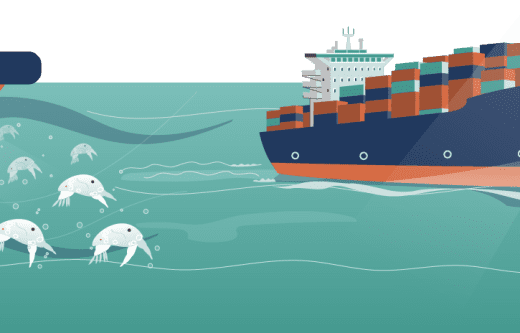
Unlocking the Science Behind Selektope®

The Discovery That Changed Marine Antifouling
International Antifouling Conference to return in 2027 as shipping industry prepares for future global biofouling rules